
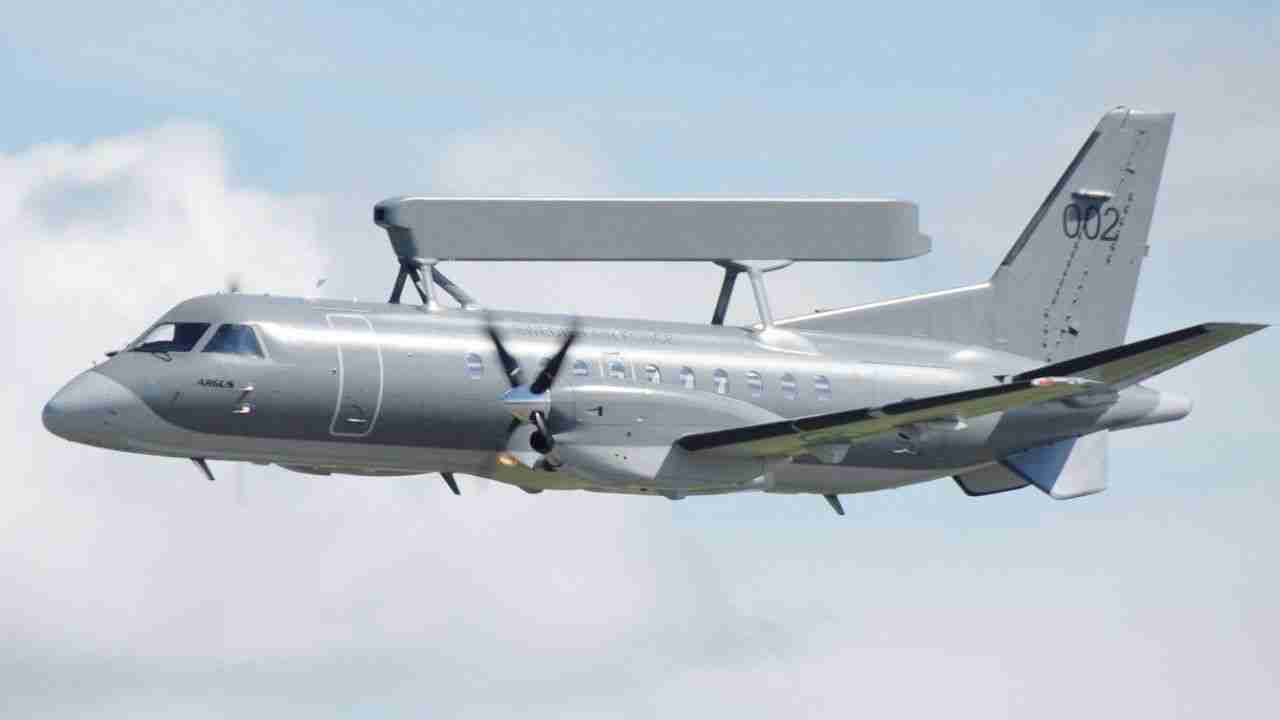
A video circulating on social media may have revealed, for the first time, the operation of a Saab 340 AEW&C airborne early warning aircraft in service in Ukraine.
The footage, whose authenticity has not yet been confirmed, shows the aircraft equipped with its distinctive radar mounted above the fuselage. If verified, the recording would mark the operational introduction of an unprecedented strategic capability for the Ukrainian Air Force.
The delivery of two units of the model by Sweden was announced in May 2024 as part of a broader military aid package. Since then, only indirect signs of its operation had emerged, including flight tracking in the Lviv region. The process involved crew training and infrastructure adaptation, which likely took about a year before possible operational deployment.
The Saab 340 AEW&C’s main advantage is its Erieye radar, capable of detecting air and maritime targets at long ranges and monitoring hundreds of threats simultaneously. With this technology, Ukraine significantly enhances its surveillance capabilities, especially against drones and low-altitude cruise missiles. The aircraft can also coordinate interceptions by relaying data to fighter jets and air defense systems.
Despite the operational benefits, the use of these aircraft carries risks. Considered high-value targets, they must operate far from combat zones, with frequent relocations between bases to avoid attacks. With only two units available, continuous airspace coverage is not possible, reinforcing the strategic and limited nature of this new asset in Ukraine’s defense.
+ U.S. agency expands investigation into Tesla’s autonomous driving system
Source: The War Zone | Photo: X @markito0171 | This content was created with the help of AI and reviewed by the editorial team
🇸🇪Saab 360 AEW&C airborne early warning and targeting aircraft “transferred” to #Kyiv & conducted its first test flight over the #Lviv region in western
🇺🇦#Ukraine pic.twitter.com/f9gMSDTM1S— C4H10FO2P ☠️ (@markito0171) April 21, 2025
Russians are posting footage they claim shows likely a Swedish Saab 340 AEW&C long-range radar and control aircraft flying over Ukraine. pic.twitter.com/XkFZlok2B3
— WarTranslated (@wartranslated) March 20, 2026
